Publications
Publication List with Images
2026 |
|
Nwankwo, Linus; Alaran, Muslim; Rauch, Christian; Obilikpa, Stanley Chukwuebuka; Rueckert, Elmar 2026, visited: 22.09.2026. Abstract | Links | BibTeX | Tags: Applied Deep Learning, computer vision @online{nwankwo2026ProBench,Open-vocabulary visual grounding enables robots to localise task-relevant entities from natural-language queries without dependence on predefined perceptual taxonomies. However, existing benchmarks largely rely on short category labels and web-scraped imagery, leaving it unclear whether open-vocabulary models can robustly ground diverse queries and visual conditions under real deployments. We introduce textbf{Pro-Bench}, a prompt-conditioned benchmark for open-vocabulary visual grounding in heterogeneous, real-world environments. Pro-Bench includes 13k+ RGB frames from independent robotic domains (subterranean, industrial, indoor, outdoor, urban), with 74.5k manual instance annotations and 515 target queries covering categorical, attributive, relational, affordance, state, part-whole, negative, and compositional semantics. We benchmarked 16 open-vocabulary model configurations in strict zero-shot inference, measuring localisation accuracy across IoU thresholds, end-to-end inference latency, prompt-induced performance variation, and target recovery consistency. Our results show that prompt-robustness is strongly architecture-dependent. Most model configurations (10/16) perform best with short category labels, whereas free-form queries yield the highest accuracy for only one. Moreover, similar aggregate mAP can conceal substantial differences in consistent target recovery across reformulations. Pro-Bench enables systematic evaluation of these gaps and supports prompt-robust visual grounding. Pro-Bench: https://pro-bench.github.io/ | 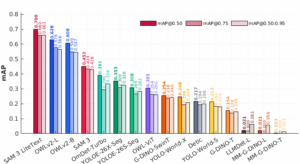 |
Ellensohn, Björn; Rueckert*, Elmar; Rauch*, Christian EliGSiR: Continual RGB-D Mapping with Gaussian Splatting under Bounded Compute Online 2026. Abstract | Links | BibTeX | Tags: computer vision, Gaussian Splatting, mobile navigation, SLAM @online{Ellensohn2026,Conventional 3D Gaussian Splatting assumes a closed set of observations and long optimization schedules. Continual RGB-D mapping in contrast poses the problem that new observations arrive online, while previously reconstructed regions must be preserved. We present EliGSiR (Evidence-guided Load-adaptive Incremental Gaussian Splatting with Image Replay), a continual Gaussian mapper that controls how the available optimization budget is used as the reconstruction evolves. Map-Guided View Scheduling filters redundant incoming views and reconsiders retained views according to the current state of the map. Load-Adaptive Fidelity adjusts supervision resolution to the current mapping load instead of following a fixed resolution schedule. Targeted Geometry Growth separates depth supervision from Gaussian creation and adds geometric capacity only where repeated RGB-D observations indicate missing or misplaced structure. Together, these mechanisms adapt which views are optimized, how much image detail is used, and where the representation grows while mapping remains active. We evaluate EliGSiR on Replica, TUM RGB-D, ScanNet++, and real RGB-D sensor sequences, considering both the final reconstruction and the map available throughout acquisition. On TUM RGB-D fr3/long_office_household, EliGSiR reaches 21.52 dB with the same ground-truth mapping poses used by the controlled baselines, compared with 19.42 dB for SplaTAM. In the tracked-pose comparison, EliGSiR with live ORB-SLAM3 poses reaches 23.02 dB in 155.5 s, compared with 20.10 dB in 230.9 s for CaRtGS using its native tracker. We further evaluate reconstruction throughout acquisition and show how EliGSiR adaptive view scheduling, supervision fidelity, and geometry growth improve the use of the available mapping budget. | 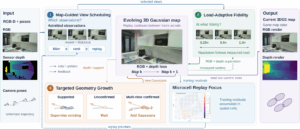 |
2024 |
|
Dave, Vedant; Rueckert, Elmar Denoised Predictive Imagination: An Information-theoretic approach for learning World Models Conference European Workshop on Reinforcement Learning (EWRL), 2024. Abstract | Links | BibTeX | Tags: computer vision, Contrastive Learning, Reinforcement Learning, Representation Learning @conference{dpidave2024,Humans excel at isolating relevant information from noisy data to predict the behavior of dynamic systems, effectively disregarding non-informative, temporally-correlated noise. In contrast, existing reinforcement learning algorithms face challenges in generating noise-free predictions within high-dimensional, noise-saturated environments, especially when trained on world models featuring realistic background noise extracted from natural video streams. We propose a novel information-theoretic approach that learn world models based on minimising the past information and retaining maximal information about the future, aiming at simultaneously learning control policies and at producing denoised predictions. Utilizing Soft Actor-Critic agents augmented with an information-theoretic auxiliary loss, we validate our method's effectiveness on complex variants of the standard DeepMind Control Suite tasks, where natural videos filled with intricate and task-irrelevant information serve as a background. Experimental results demonstrate that our model outperforms nine state-of-the-art approaches in various settings where natural videos serve as dynamic background noise. Our analysis also reveals that all these methods encounter challenges in more complex environments. | 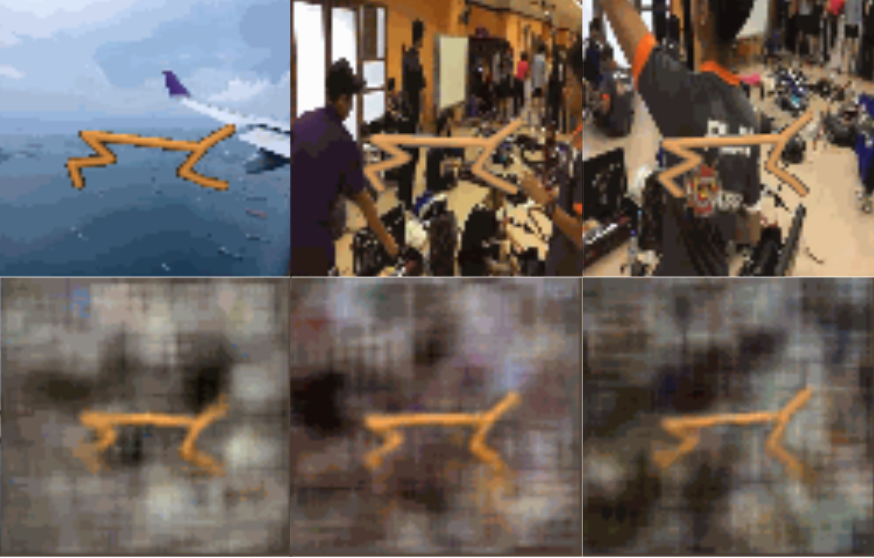 |
Neubauer, Melanie; Rueckert, Elmar Semi-Autonomous Fast Object Segmentation and Tracking Tool for Industrial Applications Proceedings Article In: IEEE International Conference on Ubiquitous Robots (UR 2024), IEEE 2024. Links | BibTeX | Tags: computer vision, Deep Learning, Recycling @inproceedings{neubauer2024fost, | 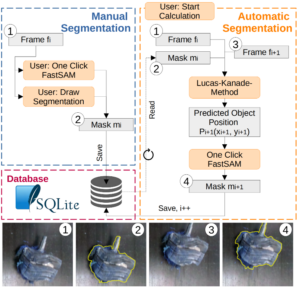 |
Compact List without Images
Conferences |
Dave, Vedant; Rueckert, Elmar Denoised Predictive Imagination: An Information-theoretic approach for learning World Models Conference European Workshop on Reinforcement Learning (EWRL), 2024. @conference{dpidave2024,Humans excel at isolating relevant information from noisy data to predict the behavior of dynamic systems, effectively disregarding non-informative, temporally-correlated noise. In contrast, existing reinforcement learning algorithms face challenges in generating noise-free predictions within high-dimensional, noise-saturated environments, especially when trained on world models featuring realistic background noise extracted from natural video streams. We propose a novel information-theoretic approach that learn world models based on minimising the past information and retaining maximal information about the future, aiming at simultaneously learning control policies and at producing denoised predictions. Utilizing Soft Actor-Critic agents augmented with an information-theoretic auxiliary loss, we validate our method's effectiveness on complex variants of the standard DeepMind Control Suite tasks, where natural videos filled with intricate and task-irrelevant information serve as a background. Experimental results demonstrate that our model outperforms nine state-of-the-art approaches in various settings where natural videos serve as dynamic background noise. Our analysis also reveals that all these methods encounter challenges in more complex environments. |
Proceedings Articles |
Neubauer, Melanie; Rueckert, Elmar Semi-Autonomous Fast Object Segmentation and Tracking Tool for Industrial Applications Proceedings Article In: IEEE International Conference on Ubiquitous Robots (UR 2024), IEEE 2024. @inproceedings{neubauer2024fost, |
Online |
Nwankwo, Linus; Alaran, Muslim; Rauch, Christian; Obilikpa, Stanley Chukwuebuka; Rueckert, Elmar 2026, visited: 22.09.2026. @online{nwankwo2026ProBench,Open-vocabulary visual grounding enables robots to localise task-relevant entities from natural-language queries without dependence on predefined perceptual taxonomies. However, existing benchmarks largely rely on short category labels and web-scraped imagery, leaving it unclear whether open-vocabulary models can robustly ground diverse queries and visual conditions under real deployments. We introduce textbf{Pro-Bench}, a prompt-conditioned benchmark for open-vocabulary visual grounding in heterogeneous, real-world environments. Pro-Bench includes 13k+ RGB frames from independent robotic domains (subterranean, industrial, indoor, outdoor, urban), with 74.5k manual instance annotations and 515 target queries covering categorical, attributive, relational, affordance, state, part-whole, negative, and compositional semantics. We benchmarked 16 open-vocabulary model configurations in strict zero-shot inference, measuring localisation accuracy across IoU thresholds, end-to-end inference latency, prompt-induced performance variation, and target recovery consistency. Our results show that prompt-robustness is strongly architecture-dependent. Most model configurations (10/16) perform best with short category labels, whereas free-form queries yield the highest accuracy for only one. Moreover, similar aggregate mAP can conceal substantial differences in consistent target recovery across reformulations. Pro-Bench enables systematic evaluation of these gaps and supports prompt-robust visual grounding. Pro-Bench: https://pro-bench.github.io/ |
Ellensohn, Björn; Rueckert*, Elmar; Rauch*, Christian EliGSiR: Continual RGB-D Mapping with Gaussian Splatting under Bounded Compute Online 2026. @online{Ellensohn2026,Conventional 3D Gaussian Splatting assumes a closed set of observations and long optimization schedules. Continual RGB-D mapping in contrast poses the problem that new observations arrive online, while previously reconstructed regions must be preserved. We present EliGSiR (Evidence-guided Load-adaptive Incremental Gaussian Splatting with Image Replay), a continual Gaussian mapper that controls how the available optimization budget is used as the reconstruction evolves. Map-Guided View Scheduling filters redundant incoming views and reconsiders retained views according to the current state of the map. Load-Adaptive Fidelity adjusts supervision resolution to the current mapping load instead of following a fixed resolution schedule. Targeted Geometry Growth separates depth supervision from Gaussian creation and adds geometric capacity only where repeated RGB-D observations indicate missing or misplaced structure. Together, these mechanisms adapt which views are optimized, how much image detail is used, and where the representation grows while mapping remains active. We evaluate EliGSiR on Replica, TUM RGB-D, ScanNet++, and real RGB-D sensor sequences, considering both the final reconstruction and the map available throughout acquisition. On TUM RGB-D fr3/long_office_household, EliGSiR reaches 21.52 dB with the same ground-truth mapping poses used by the controlled baselines, compared with 19.42 dB for SplaTAM. In the tracked-pose comparison, EliGSiR with live ORB-SLAM3 poses reaches 23.02 dB in 155.5 s, compared with 20.10 dB in 230.9 s for CaRtGS using its native tracker. We further evaluate reconstruction throughout acquisition and show how EliGSiR adaptive view scheduling, supervision fidelity, and geometry growth improve the use of the available mapping budget. |