

Publication List with Images
2026 |
|
Gottam, Sai Puneeth Reddy; Rueckert*, Elmar; Dave*, Vedant InfiNoVA: Infinite Novel View Augmentation for Viewpoint Invariant Robot Policies Online 2026, visited: 23.09.2026, (* equal supervision). Abstract | Links | BibTeX | Tags: Gaussian Splatting, Manipulation, Representation Learning, VLA @online{puneethinfinova2026,Vision-Language-Action (VLA) policies often rely strongly on the camera viewpoints seen during training, causing substantial performance degradation when deployed from unseen perspectives. Collecting demonstrations from sufficiently diverse physical viewpoints is expensive and still provides only sparse coverage of the viewpoint space. We introduce InfiNoVA, a data-augmentation framework that converts synchronized multi-camera demonstrations into a dense distribution of geometrically consistent training views. InfiNoVA reconstructs each manipulation trajectory as a time-varying 3D Gaussian representation and renders novel observations from sampled camera poses while preserving the original state–action correspondence. This explicit scene representation improves frame-level fidelity and temporal consistency while reducing task-critical hallucinations observed in generative novel-view synthesis. Across four real-world manipulation tasks, policies trained with InfiNoVA achieve 5.4× higher average success under unseen randomized viewpoints than both VISTA-based augmentation and the unaugmented policy. InfiNoVA further achieves 1.7× higher success than training directly on all five physical camera views. These results show that dense, geometrically grounded viewpoint augmentation provides a practical route toward camera-robust robot policies without modifying the underlying policy architecture. | 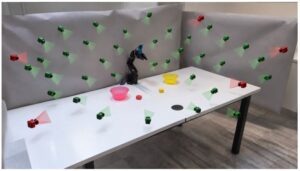 |
Ellensohn, Björn; Rueckert*, Elmar; Rauch*, Christian EliGSiR: Continual RGB-D Mapping with Gaussian Splatting under Bounded Compute Online 2026. Abstract | Links | BibTeX | Tags: computer vision, Gaussian Splatting, mobile navigation, SLAM @online{Ellensohn2026,Conventional 3D Gaussian Splatting assumes a closed set of observations and long optimization schedules. Continual RGB-D mapping in contrast poses the problem that new observations arrive online, while previously reconstructed regions must be preserved. We present EliGSiR (Evidence-guided Load-adaptive Incremental Gaussian Splatting with Image Replay), a continual Gaussian mapper that controls how the available optimization budget is used as the reconstruction evolves. Map-Guided View Scheduling filters redundant incoming views and reconsiders retained views according to the current state of the map. Load-Adaptive Fidelity adjusts supervision resolution to the current mapping load instead of following a fixed resolution schedule. Targeted Geometry Growth separates depth supervision from Gaussian creation and adds geometric capacity only where repeated RGB-D observations indicate missing or misplaced structure. Together, these mechanisms adapt which views are optimized, how much image detail is used, and where the representation grows while mapping remains active. We evaluate EliGSiR on Replica, TUM RGB-D, ScanNet++, and real RGB-D sensor sequences, considering both the final reconstruction and the map available throughout acquisition. On TUM RGB-D fr3/long_office_household, EliGSiR reaches 21.52 dB with the same ground-truth mapping poses used by the controlled baselines, compared with 19.42 dB for SplaTAM. In the tracked-pose comparison, EliGSiR with live ORB-SLAM3 poses reaches 23.02 dB in 155.5 s, compared with 20.10 dB in 230.9 s for CaRtGS using its native tracker. We further evaluate reconstruction throughout acquisition and show how EliGSiR adaptive view scheduling, supervision fidelity, and geometry growth improve the use of the available mapping budget. | 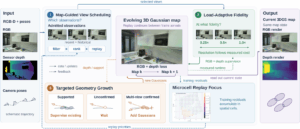 |
Compact List without Images
Online |
Gottam, Sai Puneeth Reddy; Rueckert*, Elmar; Dave*, Vedant InfiNoVA: Infinite Novel View Augmentation for Viewpoint Invariant Robot Policies Online 2026, visited: 23.09.2026, (* equal supervision). @online{puneethinfinova2026,Vision-Language-Action (VLA) policies often rely strongly on the camera viewpoints seen during training, causing substantial performance degradation when deployed from unseen perspectives. Collecting demonstrations from sufficiently diverse physical viewpoints is expensive and still provides only sparse coverage of the viewpoint space. We introduce InfiNoVA, a data-augmentation framework that converts synchronized multi-camera demonstrations into a dense distribution of geometrically consistent training views. InfiNoVA reconstructs each manipulation trajectory as a time-varying 3D Gaussian representation and renders novel observations from sampled camera poses while preserving the original state–action correspondence. This explicit scene representation improves frame-level fidelity and temporal consistency while reducing task-critical hallucinations observed in generative novel-view synthesis. Across four real-world manipulation tasks, policies trained with InfiNoVA achieve 5.4× higher average success under unseen randomized viewpoints than both VISTA-based augmentation and the unaugmented policy. InfiNoVA further achieves 1.7× higher success than training directly on all five physical camera views. These results show that dense, geometrically grounded viewpoint augmentation provides a practical route toward camera-robust robot policies without modifying the underlying policy architecture. |
Ellensohn, Björn; Rueckert*, Elmar; Rauch*, Christian EliGSiR: Continual RGB-D Mapping with Gaussian Splatting under Bounded Compute Online 2026. @online{Ellensohn2026,Conventional 3D Gaussian Splatting assumes a closed set of observations and long optimization schedules. Continual RGB-D mapping in contrast poses the problem that new observations arrive online, while previously reconstructed regions must be preserved. We present EliGSiR (Evidence-guided Load-adaptive Incremental Gaussian Splatting with Image Replay), a continual Gaussian mapper that controls how the available optimization budget is used as the reconstruction evolves. Map-Guided View Scheduling filters redundant incoming views and reconsiders retained views according to the current state of the map. Load-Adaptive Fidelity adjusts supervision resolution to the current mapping load instead of following a fixed resolution schedule. Targeted Geometry Growth separates depth supervision from Gaussian creation and adds geometric capacity only where repeated RGB-D observations indicate missing or misplaced structure. Together, these mechanisms adapt which views are optimized, how much image detail is used, and where the representation grows while mapping remains active. We evaluate EliGSiR on Replica, TUM RGB-D, ScanNet++, and real RGB-D sensor sequences, considering both the final reconstruction and the map available throughout acquisition. On TUM RGB-D fr3/long_office_household, EliGSiR reaches 21.52 dB with the same ground-truth mapping poses used by the controlled baselines, compared with 19.42 dB for SplaTAM. In the tracked-pose comparison, EliGSiR with live ORB-SLAM3 poses reaches 23.02 dB in 155.5 s, compared with 20.10 dB in 230.9 s for CaRtGS using its native tracker. We further evaluate reconstruction throughout acquisition and show how EliGSiR adaptive view scheduling, supervision fidelity, and geometry growth improve the use of the available mapping budget. |