

Publication List with Images
2026 |
|
Soni, Krishnam; Sehgal, Aditya; Dave*, Vedant; Rückert*, Elmar ALRA: Action-Latent Residual Adaptation for World Models Workshop NeurIPS 2026 Workshop on Towards Test-Time Continual Learning Agents, NeurIPS 2026 Workshop on Continual Learning in the Era of Foundation Models and Embodied Agents, NeurIPS 2026 Workshop on PTA: From Pretrained Representations to Acting Agents, 2026, (* equal supervision). Abstract | Links | BibTeX | Tags: Representation Learning, Test-time Adaptation, World Models @workshop{krishnamalra2026,Latent world models degrade when deployed under unseen dynamics shifts. Recent test-time adaptation methods such as AdaJEPA address this by fine-tuning selected sub-networks of the predictor and visual encoder online, updating on the order of 100M parameters within every episode. We show that such updates are unnecessary when the shift acts on the agent's own dynamics: a 210-parameter affine residual applied to the action embedding, with all encoders and the predictor left entirely frozen, recovers as much planning performance as sub-network fine-tuning. On PointMaze-Medium, this residual matches the strongest AdaJEPA baseline under all three shifts: 50x a damping increase, a 0.2x mass reduction, and a 10x mass increase, improving over the frozen baseline in each while leaving in-distribution performance unchanged, and updating four orders of magnitude fewer parameters. Our results suggest that dynamics shifts which rescale how commanded actions translate into motion can be corrected entirely in action space, leaving the learned visual and proprioceptive representation untouched. | 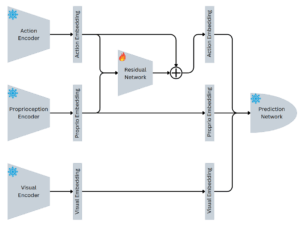 |
Soni, Krishnam; Sehgal, Aditya; Dave*, Vedant; Rückert*, Elmar Sandwich-Residuals: Parameter-Efficient Test-time Adaptation of World Models Online 2026, visited: 18.09.2026, (* equal supervision). Abstract | Links | BibTeX | Tags: Representation Learning, Test-time Adaptation, World Models @online{krishnamresi2026,Latent world models enable planning by predicting the effects of actions in a learned representation space, but their predictions can become unreliable when test-time conditions differ from training. Existing test-time adaptation methods address this by updating parts of the pretrained model, often modifying millions of parameters and requiring a choice of which internal components to adapt. We introduce SandwichResiduals, a lightweight alternative that keeps the pretrained world model frozen and learns only small residual corrections around the predictor. The residuals are optimized online using the model’s self-supervised prediction error and require no rewards, labels, or source-domain data. Across 21 conditions on the AdaJEPA benchmark, our method achieves 1.3× the success rate of the frozen model while retaining 95% of the performance of the strongest AdaJEPA variant and adapting 97–99% fewer parameters. Under compound shifts, this advantage increases to 1.9× the success rate of the frozen model, while remaining comparable to internal block adaptation. We further demonstrate the same adaptation principle on a DINO-WM model for 3-D manipulation. These results suggest that effective test-time adaptation of world models does not necessarily require modifying their pretrained internal weights. | 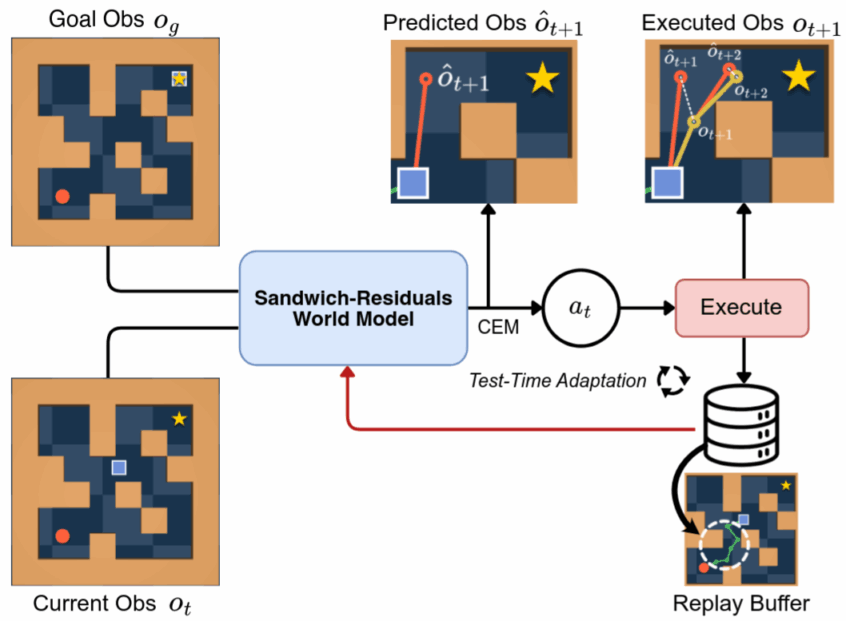 |
Compact List without Images
Online |
Soni, Krishnam; Sehgal, Aditya; Dave*, Vedant; Rückert*, Elmar Sandwich-Residuals: Parameter-Efficient Test-time Adaptation of World Models Online 2026, visited: 18.09.2026, (* equal supervision). @online{krishnamresi2026,Latent world models enable planning by predicting the effects of actions in a learned representation space, but their predictions can become unreliable when test-time conditions differ from training. Existing test-time adaptation methods address this by updating parts of the pretrained model, often modifying millions of parameters and requiring a choice of which internal components to adapt. We introduce SandwichResiduals, a lightweight alternative that keeps the pretrained world model frozen and learns only small residual corrections around the predictor. The residuals are optimized online using the model’s self-supervised prediction error and require no rewards, labels, or source-domain data. Across 21 conditions on the AdaJEPA benchmark, our method achieves 1.3× the success rate of the frozen model while retaining 95% of the performance of the strongest AdaJEPA variant and adapting 97–99% fewer parameters. Under compound shifts, this advantage increases to 1.9× the success rate of the frozen model, while remaining comparable to internal block adaptation. We further demonstrate the same adaptation principle on a DINO-WM model for 3-D manipulation. These results suggest that effective test-time adaptation of world models does not necessarily require modifying their pretrained internal weights. |
Workshops |
Soni, Krishnam; Sehgal, Aditya; Dave*, Vedant; Rückert*, Elmar ALRA: Action-Latent Residual Adaptation for World Models Workshop NeurIPS 2026 Workshop on Towards Test-Time Continual Learning Agents, NeurIPS 2026 Workshop on Continual Learning in the Era of Foundation Models and Embodied Agents, NeurIPS 2026 Workshop on PTA: From Pretrained Representations to Acting Agents, 2026, (* equal supervision). @workshop{krishnamalra2026,Latent world models degrade when deployed under unseen dynamics shifts. Recent test-time adaptation methods such as AdaJEPA address this by fine-tuning selected sub-networks of the predictor and visual encoder online, updating on the order of 100M parameters within every episode. We show that such updates are unnecessary when the shift acts on the agent's own dynamics: a 210-parameter affine residual applied to the action embedding, with all encoders and the predictor left entirely frozen, recovers as much planning performance as sub-network fine-tuning. On PointMaze-Medium, this residual matches the strongest AdaJEPA baseline under all three shifts: 50x a damping increase, a 0.2x mass reduction, and a 10x mass increase, improving over the frozen baseline in each while leaving in-distribution performance unchanged, and updating four orders of magnitude fewer parameters. Our results suggest that dynamics shifts which rescale how commanded actions translate into motion can be corrected entirely in action space, leaving the learned visual and proprioceptive representation untouched. |